“I am Arnau Falgueras, student of the Bachelor’s Degree in Video Games by UPC at CITM. This content is generated for the second year’s subject Project 2, under supervision of lecturer Marc Garrigó.”
Production Plan
What is a Production Plan?
A Production Plan is a document that helps the team to manage and organize all the different elements that will be needed during the game. This means that in this document we can find all the different key elements to make our game counted and divided into smaller and organized chunks.
Why we should do a Production Plan?
The Production Plan is an important document mainly because two reasons:
- Firstly, without it anyone (even probably your own team) will believe that this project will succeed, because without organization (the goal of this plan) most projects end in failure. This point is key when trying to get investors for your game, without a Production Plan, they will not invert.

- Secondly, without it, your own team will have problems in doing the game, mostly because as said in the first point, organization is a key factor in the success of a team. Without it, the team will be lost in some moments of the process of creation of the videogame and the progress will slow down and even halt, achieving the end of the project (if finished) in a later date than expected.

When you have to do a Production Plan?
The Production Plan should be one of the first things done during the creation of the game, more precisely, it should be done after finishing the first version of the GDD (a very simple version that will help us view which are number of the elements we need for the game).

When and how you have to update a Production Plan?
Because the Production Plan is a document that spans over all the process of creation of the game, it is normal that things that we supposed at the start will be different in later moments of the proces. This is why updating the Production Plan is a must, in order to keep the team organized at all times. Usually, this document is updated after a meeting when the team discusses what has done and what is needed to be done (this meetings are usually every week), if not it is essential that at least, after every milestone is achieved the Production Plan is updated. To update the Production Plan is usually to change the number of elements that have changed and divide (if necessary) into new chunks and organize this new chunks of elements (again, if necessary).

What contains a Production Plan?
As said before, the Production Plan organizes and manages the different key elements that are necessary in the creation of a game, these elements are people, time, tasks and money.
Staff
After knowing the scope and type of game that we will be made (usually using the GDD and the TDD or that purpose), it is necessary to decide a number of people that will work in the game, this number is the staff. This is very important because usually, most of the money used in creating games go to salaries of the people who work making the game.

Roles:
The roles section consists in giving every person that works in the game a position (or more if needed) in order to give every needed position to make the game at least to one person. This way, when doing the game, there will be always at least one person that will be able to do a task needed. This roles are very varied and depend mostly of the business, but some common roles in the videogame industry are: management, programmer, designer, artist, QA… Every one of these roles could be divided into smaller ones (in bigger companies).

Schedule
One of the most importants parts of the Production Plan (not to say the most important) is the organization of the time that the team will have in order to make the game. This time is usually organized making a schedule that will help the team to know when they have to do every task. The organization is usually done by dividing the time into milestones (smaller units of time that mark an important moment of the process, such as the alpha) and then organize what has to be done in every milestone (sometimes, this list of tasks is only given in the first milestone, and in the next update will organize the next milestone).

Another way to divide even further is through sprints, these are usually a week and they have like milestones tasks that need to be done in this time. Both milestones and sprints have a meeting before they start that helps the team see what they have done good and bad, what they could do better in the next one and what they need to do (and also what to focus).

Apart from this we can see that there are different stages of development of a videogame, as always, these stages (and their number) changes depending of who you ask (or the company that you work for). However, here we will list seven stages: planning (the team decides the game that will be made and start to decide how), pre-production (the start of prototyping and the team finishes to decide how the game will be made), production (the main work of the game, make a playable and almost done game), testing (check if the game is without bugs and is fun and with a correct difficulty), pre-launch (make an alpha and beta and start hyping the customers), launch (bug squashing and polish, finally release the game) and post-production (game balancing and patching and adding new content, DLC).

Tasks
The tasks are the things that need to be done in order to make the game, these tasks are usually small parts of a greater task (for example, make a button in the task of make the UI) and every one of these tasks should have some information, such as name (and if necessary description), date limit, time estimate, person/s assigned, dependencies with other departments…

These tasks usually have a tracking that will help the team know what it is being done, what has to be done and what is done; this obviously helps organization and efficiency. These tracking changes depending of the company but usually the tasks are divided into these four different groups: to be done (it hasn’t been started yet), to do (someone has started this task), testing (someone has finished but another has to test it to check if it works, usually the QA team) and done (this task has been done and tested and checked that works correctly). This tracking can be done physically with a board and stick notes, however, most companies use softwares that help them do this faster and in their own computers. Two of the most famous softwares used are Trello and HacknPlan.

Contingency List: A contingency list is something that helps the team when they meet a problem during the production of a game, helping them deal with the problem faster. This list usually details some problems that the team might encounter and is also explained the degree of probability that this problem will happen. Last but not least, it is explained what the team will have to do if this problem happens.

Budget
The budget (AKA the money) is an important resource that is necessary in order to produce and create a game. This part of the Production Plan declares all the money needed in order to make the game and all the money available, and then specifies how will be paid everything, usually dividing the two sums of money into sections to make it easy to manage. There are two different types of budget: the one time cost (things that will only be needed to be paid one time, such as the rights for a song) and the monthly cost (the things that need to be paid every month, such as salary or rent), this type can be fixed (the price will be always the same like the rent) or variable (the price might change every month, for example electricity). To have a great control of the budget is a thing that investors will appreciate, because at the end, their money is at stake and they would like to know what will be spend for.

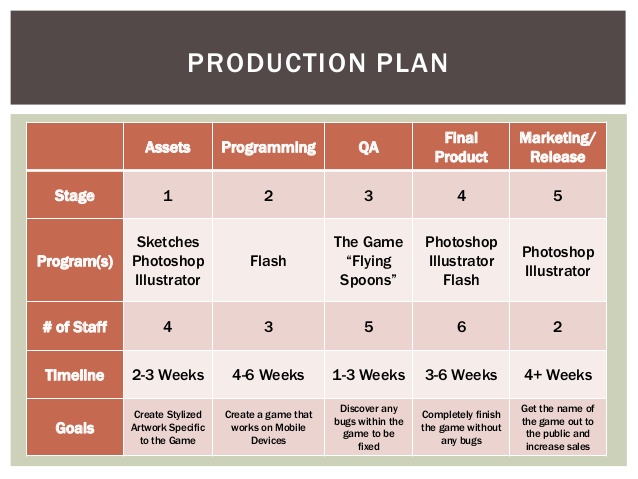
Example of a Production Plan:
Chill Chili Studio’s Production Plan
Sources:
- https://www.gamasutra.com/view/news/228260/Kellee_Santiagos_10step_video_game_production_plan.php
- https://www.slideshare.net/Kelvis2000/game-design-the-production-plan
- http://decibel.fi.muni.cz/pv255/2015/slides/PV255-2015-10–J_Kolar-Produkce.pdf
- https://www.ommzi.com/create-production-plan-concept-important-phases-consider/
- https://github.com/ChillChiliStudio/Order227/wiki/Production-Plan
- http://leonardperez.net/game-production-cycle/